Thirteen tools, grouped by the job they do.
These aren't features that came out of a product roadmap. Each tool in this suite exists because Brian Hollis ran into a real operational gap and built his way out of it.
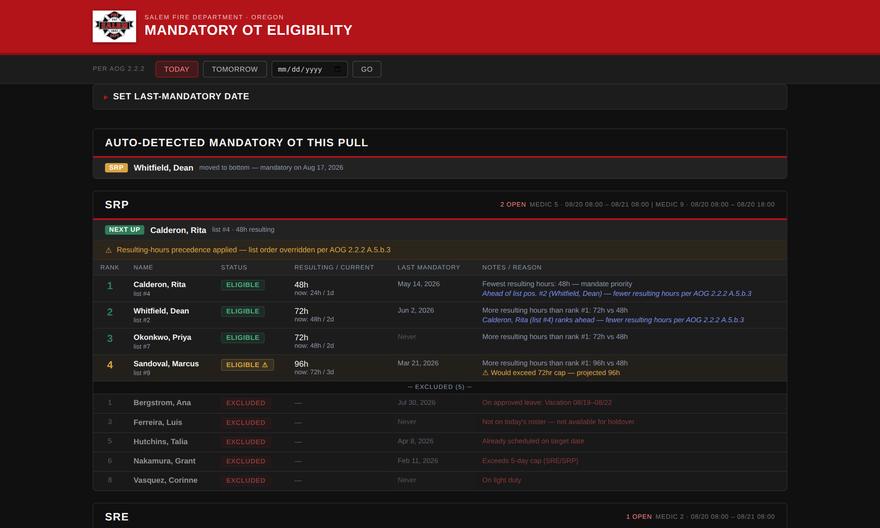
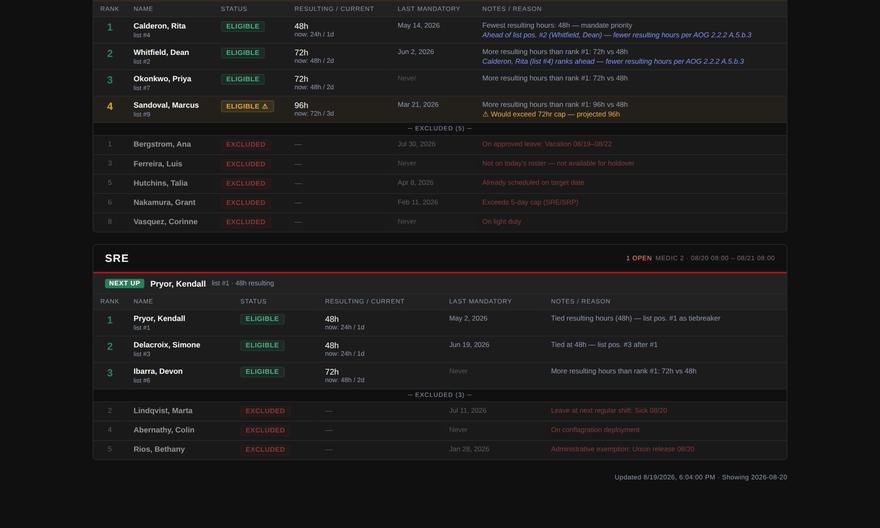
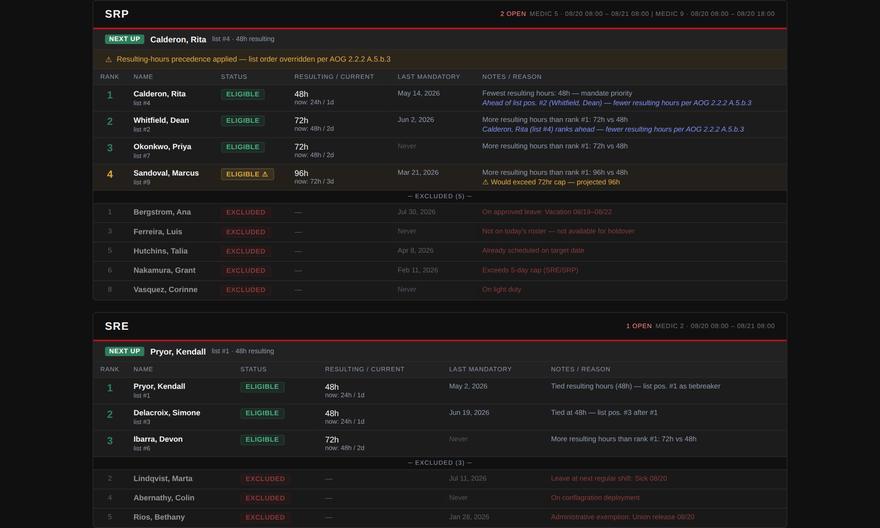
Calculates force-hire eligibility against your CBA's actual language. Consecutive day caps, hour thresholds, exemptions, rotation order. The list is ready before your shift commander needs to make the call.
- Consecutive day & hour cap tracking
- Automatic leave and exemption checks
- Force-hire rotation with pass tracking
- Legally defensible audit trail
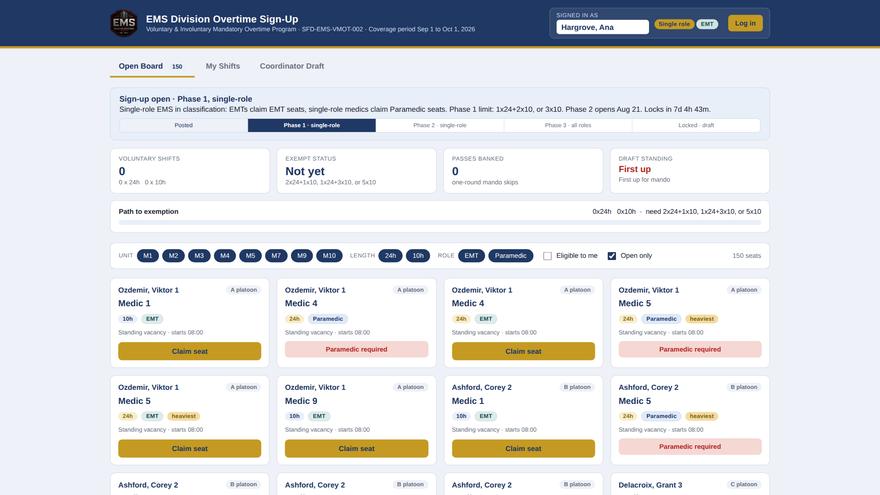
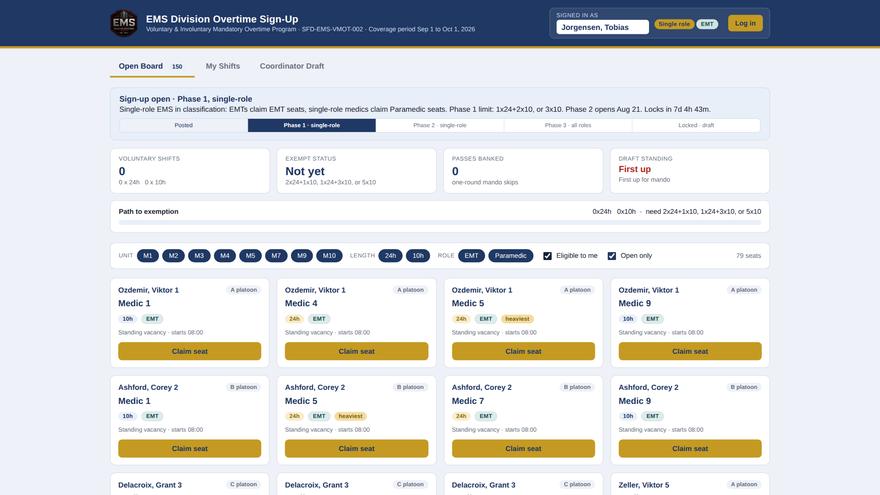
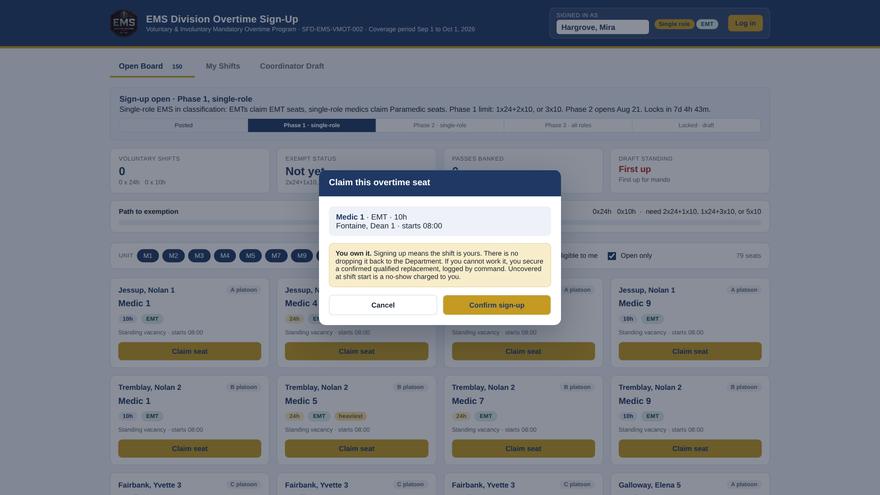
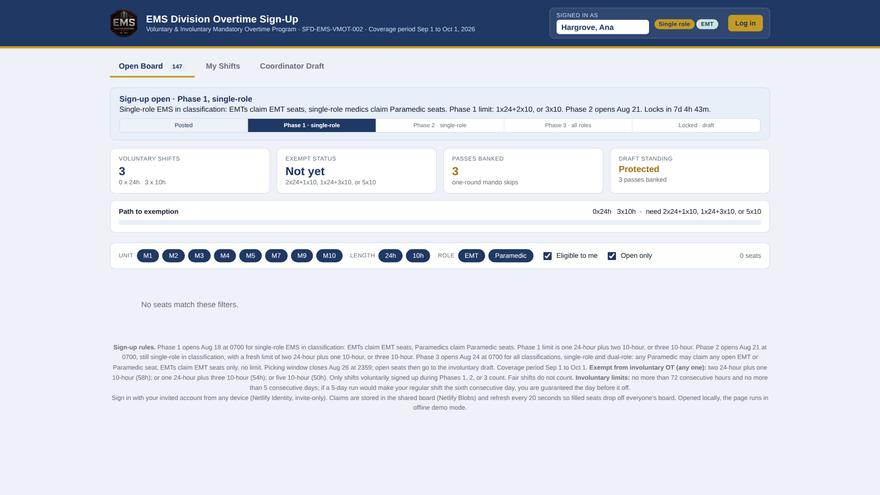
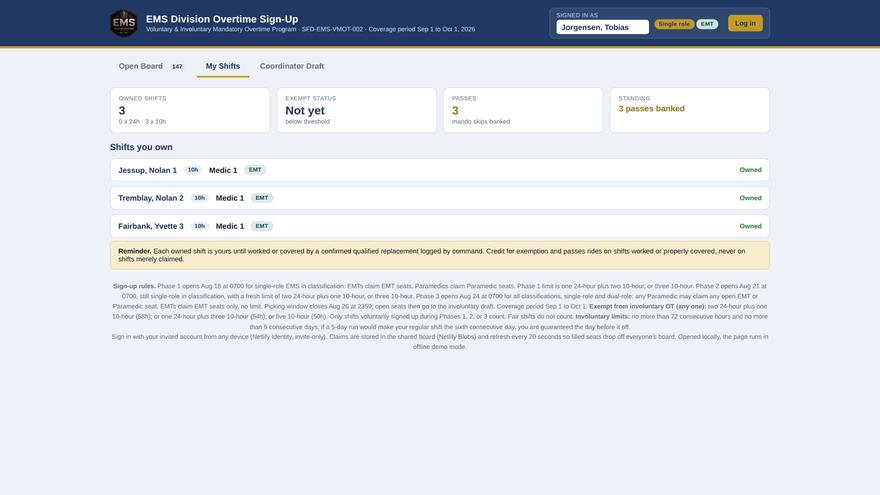
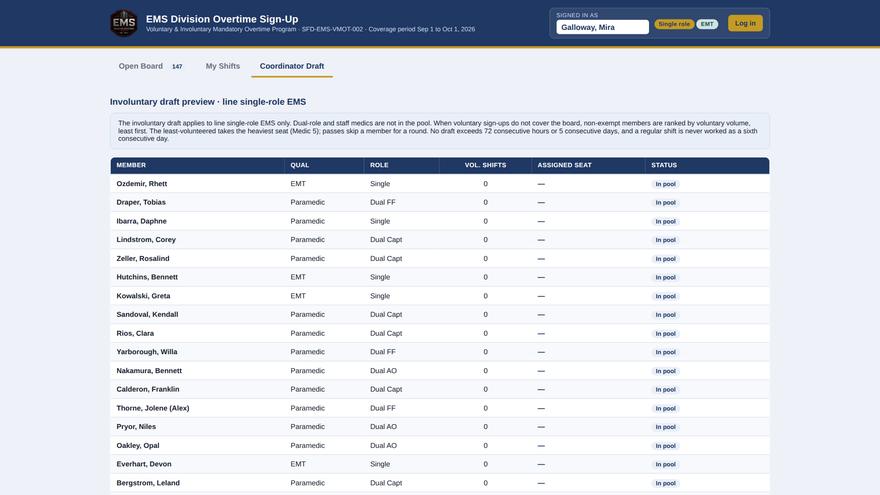
Post the whole coverage period at once and let people claim it. Every open seat for the window goes on one board, sign-up opens in phases by role class, and eligibility, hour caps and exemption thresholds are enforced as members claim rather than argued about afterward. When the window locks, the involuntary draft order is already built.
- Full coverage window posted as claimable seats, not a blank calendar
- Phased sign-up windows by role class with a live countdown to lock
- Eligibility enforced at claim time — qualification, hour caps, rest rules
- Exemption progress and banked passes tracked per member, in real time
- Involuntary draft order ranked automatically by voluntary volume
- Shared board refreshes across devices so filled seats drop off everyone’s view
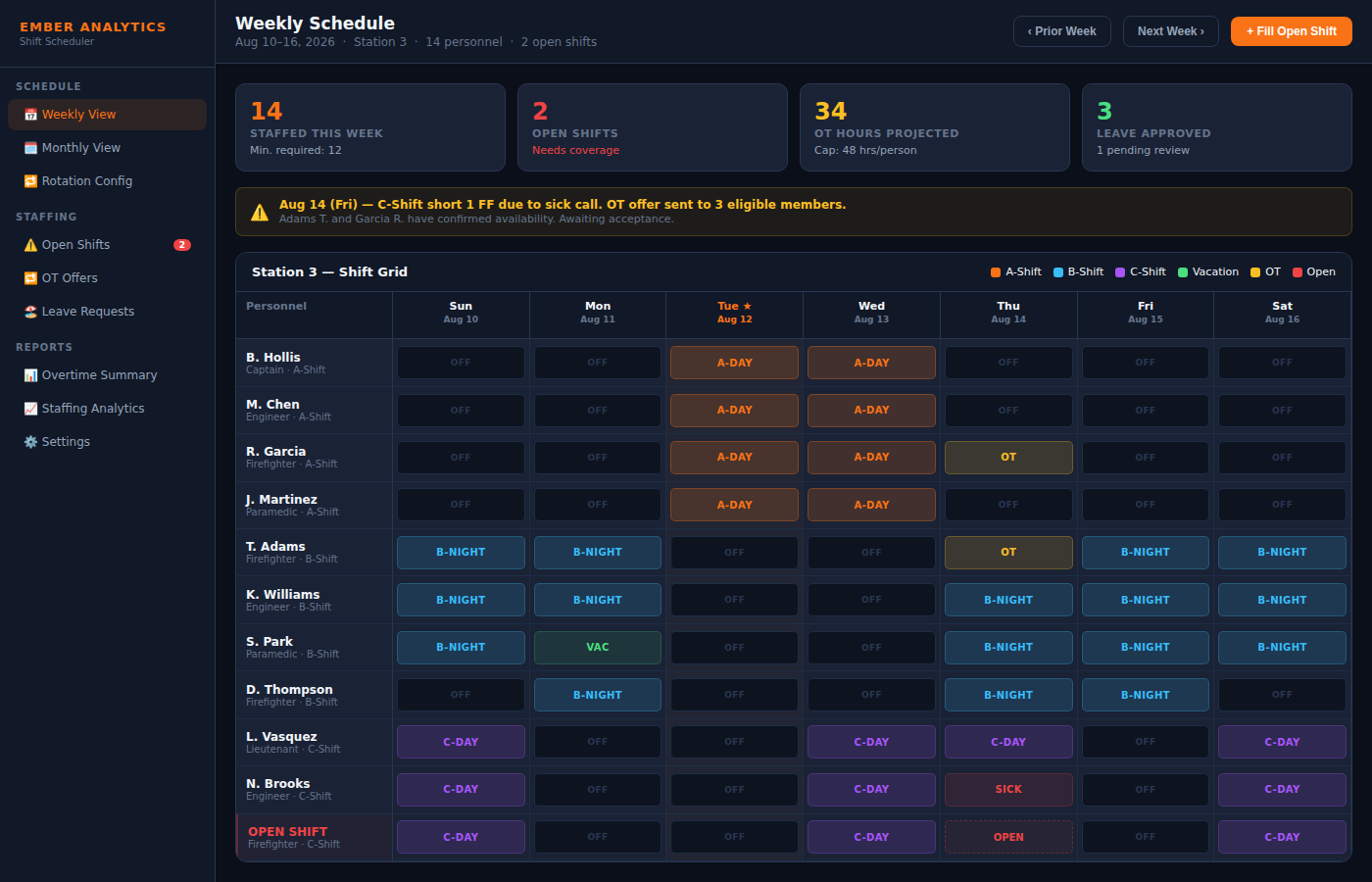
Shift scheduling built by a fire captain, not a software vendor. Handles 24/48, 24/72, 48/96, Kelly cycles, Debit Days, and hybrid rotations without forcing your department to bend to a template. Overtime tracking, leave management, and open-shift notifications are built in from the start.
- Automatic CBA-aware OT eligibility list
- Open shift broadcast with accept/decline workflow
- Leave request approval with coverage checks
- Week, month, and rotation-cycle views
- Minimum staffing alerts before they become a problem
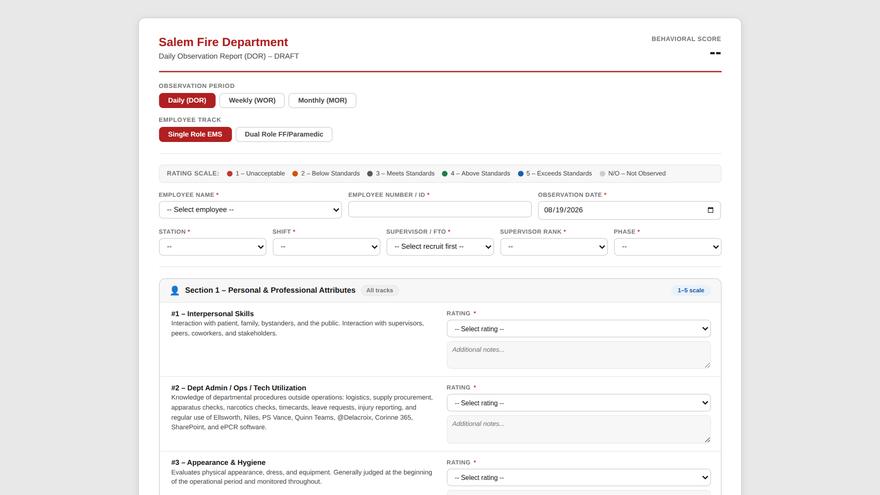
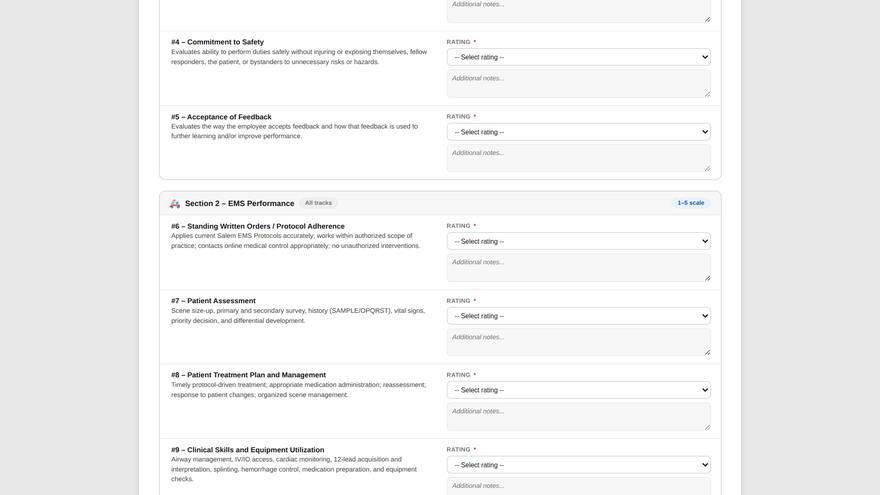
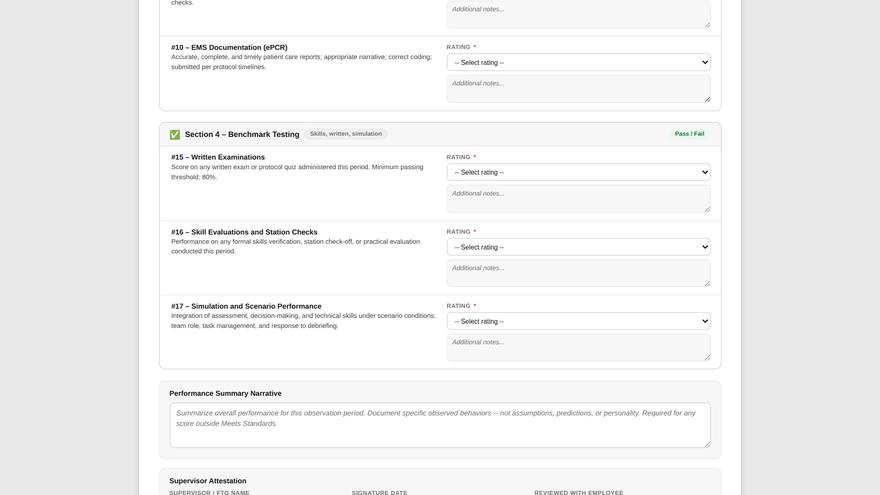
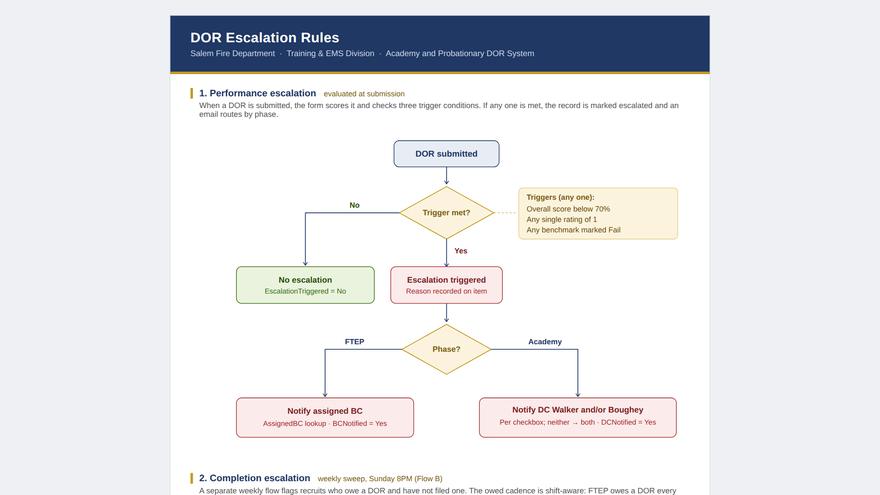
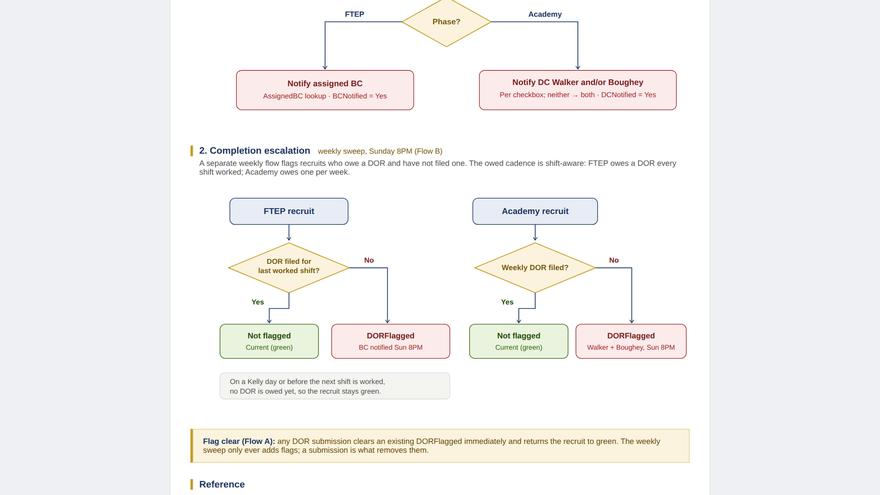
Digital DORs and FTEP milestone tracking for probationary firefighters. Every shift documented, FTO sign-offs recorded, performance trends visible to supervisors without digging through paper binders.
- Daily observation report forms (DOR)
- Probationary milestone tracking
- Field training officer assignment & sign-off
- Performance trend visibility for supervisors
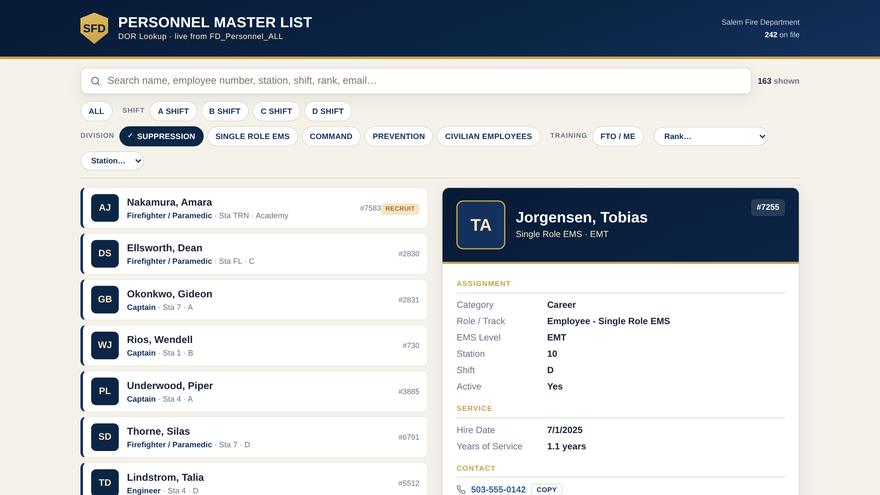
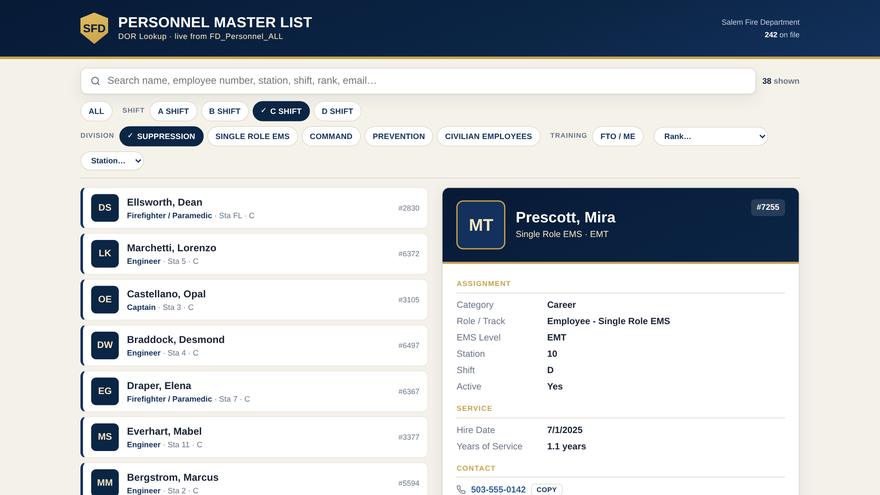
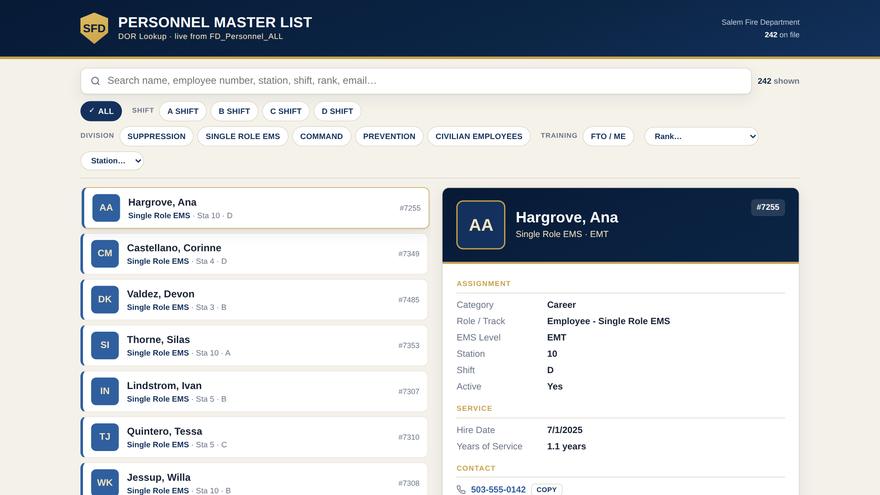
One roster of record that every other tool reads from. Assignment, rank, station, shift, EMS level, hire date and contact info stay in one place, and the DOR, sign-up and eligibility tools pull their name lists from it instead of each keeping a copy that drifts.
- Single source of truth feeding DOR, scheduling and eligibility lookups
- Filter by division, shift, rank or station — stackable, instant
- Full member record: assignment, EMS level, service dates, contact
- FTO and training qualifications flagged on the member
- Search by name, employee number, station, rank or email
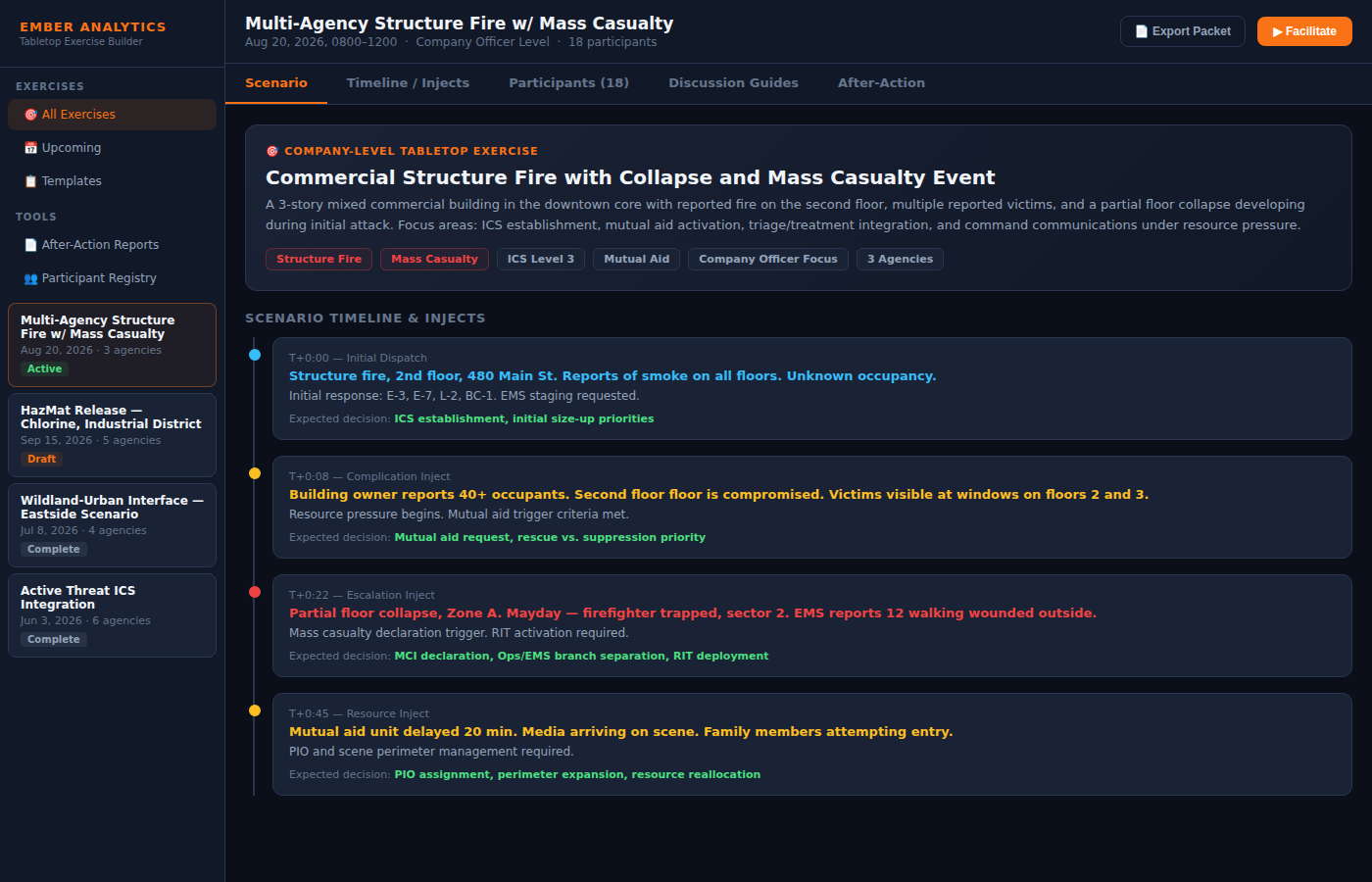
Scenario design and facilitation for company and command-level training exercises. Build a credible multi-agency tabletop in hours, with documentation that holds up to after-action review.
- Customizable scenario templates
- Multi-agency exercise coordination
- Participant sign-up and tracking
- After-action documentation
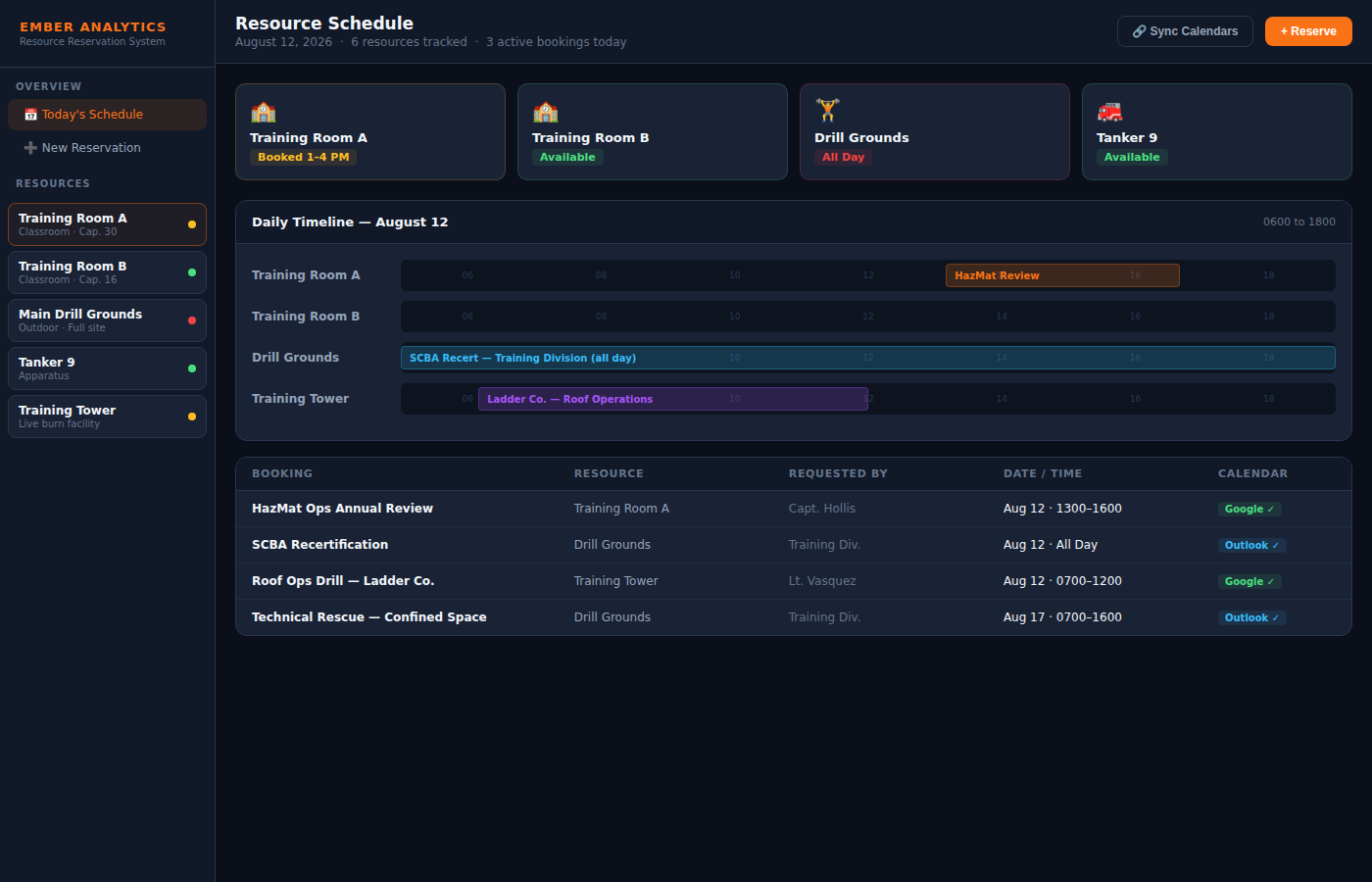
Self-service booking for classrooms, apparatus, training equipment, and drill grounds. Confirmations go out automatically. Events write directly to Google or Outlook calendars.
- Classrooms, apparatus & equipment booking
- Drill ground & training facility scheduling
- Automated email & notification alerts
- Calendar write-back (Google / Outlook)
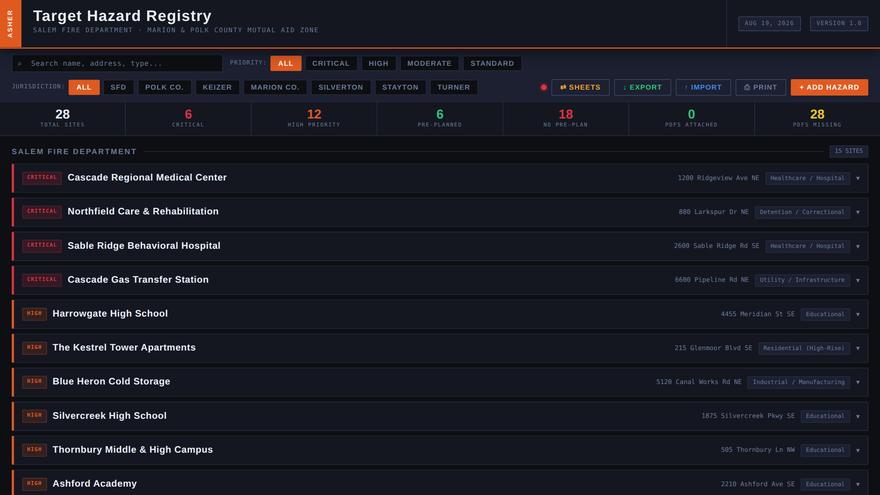
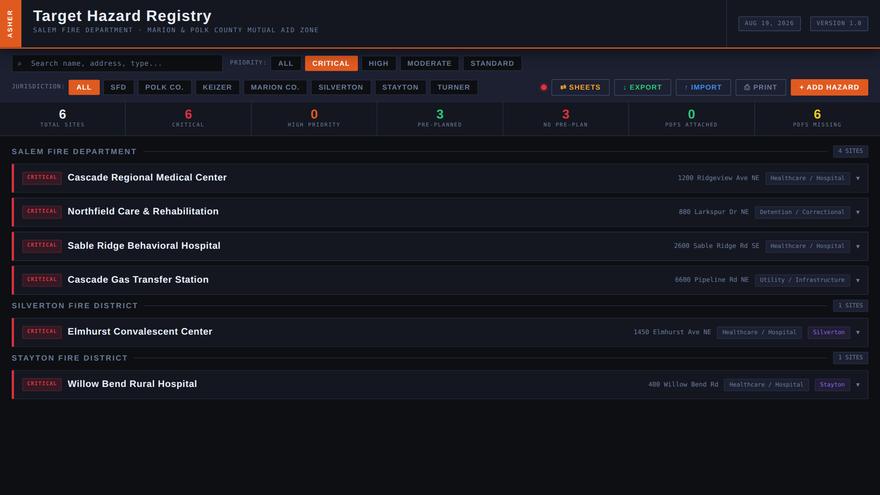
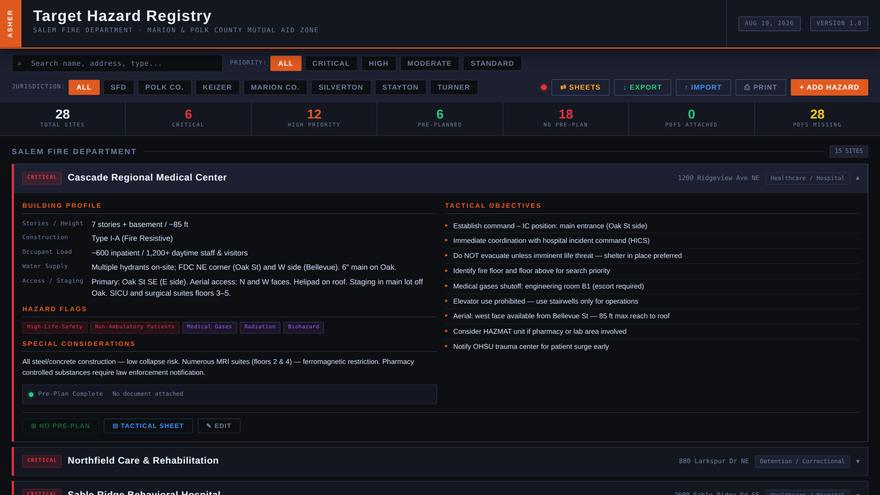
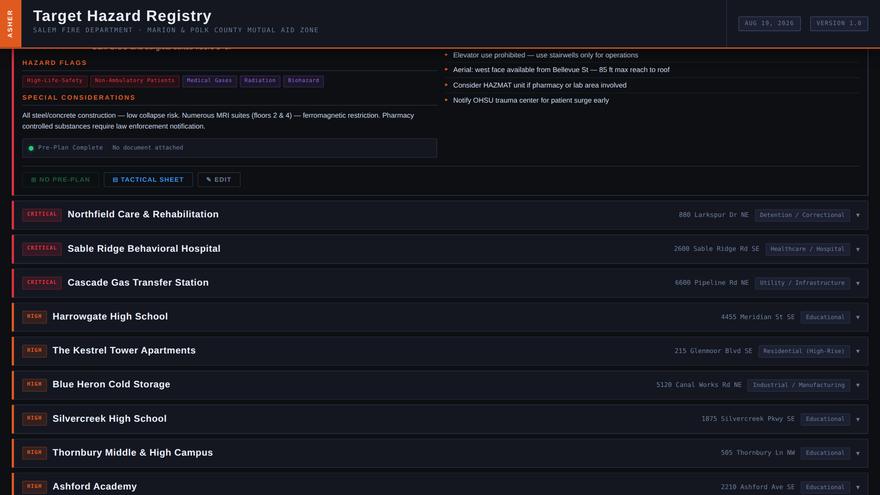
Pre-incident planning built for suppression crews, not administrators. Every target hazard in the mutual aid zone documented, ranked by priority, and readable in the seconds you have on the way in — building profile, hazard flags, water supply, access, and the tactical objectives that follow from them.
- Facility-level hazard documentation
- Suppression crew quick-reference views
- Map-integrated critical infrastructure
- Access, utility & contact information
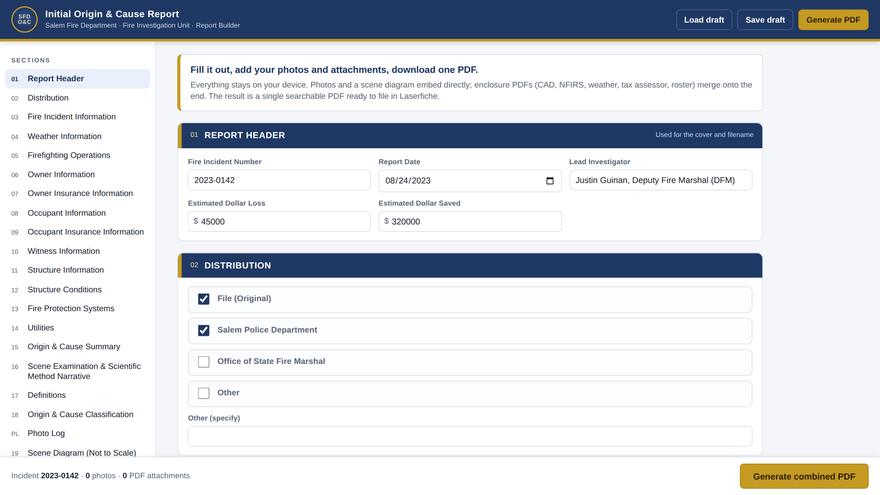
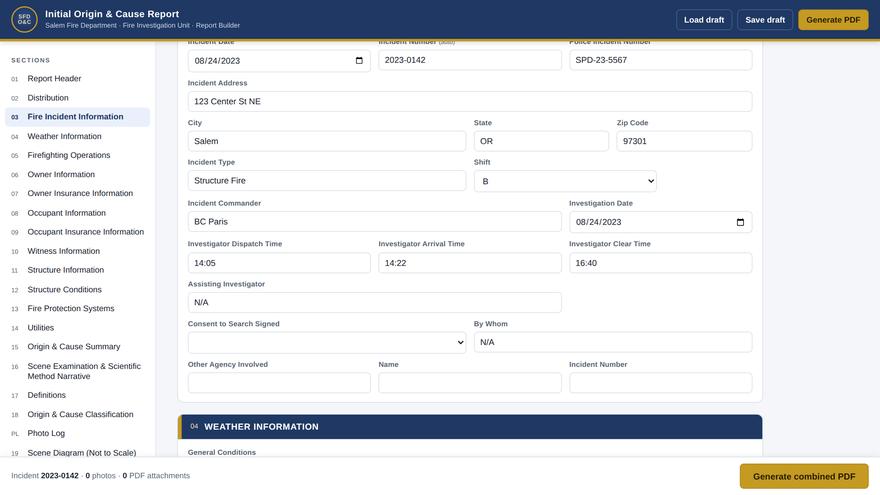
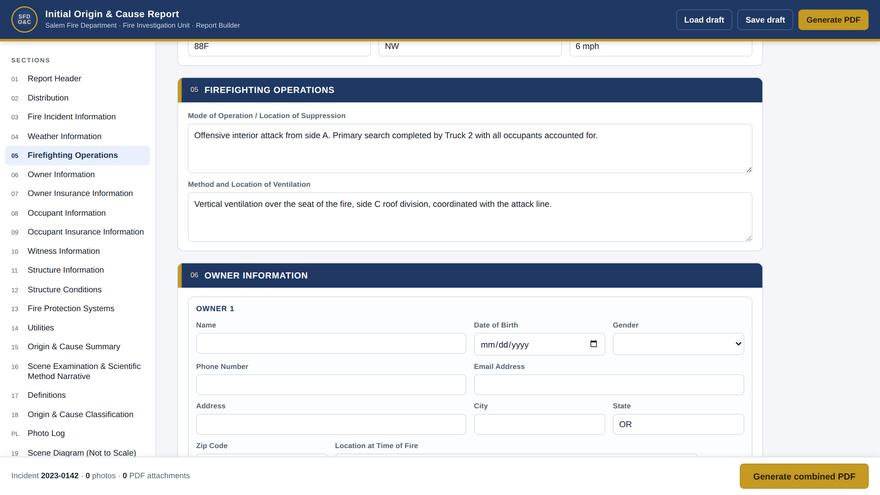
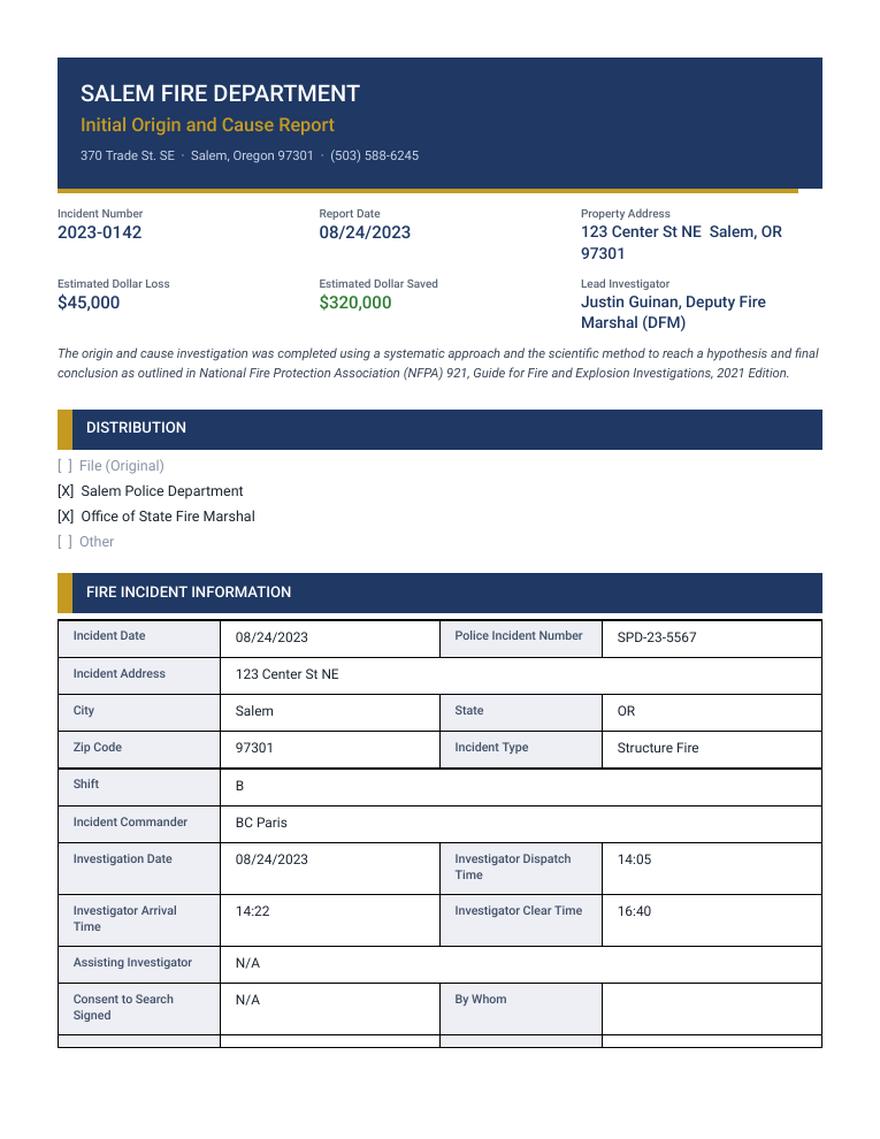
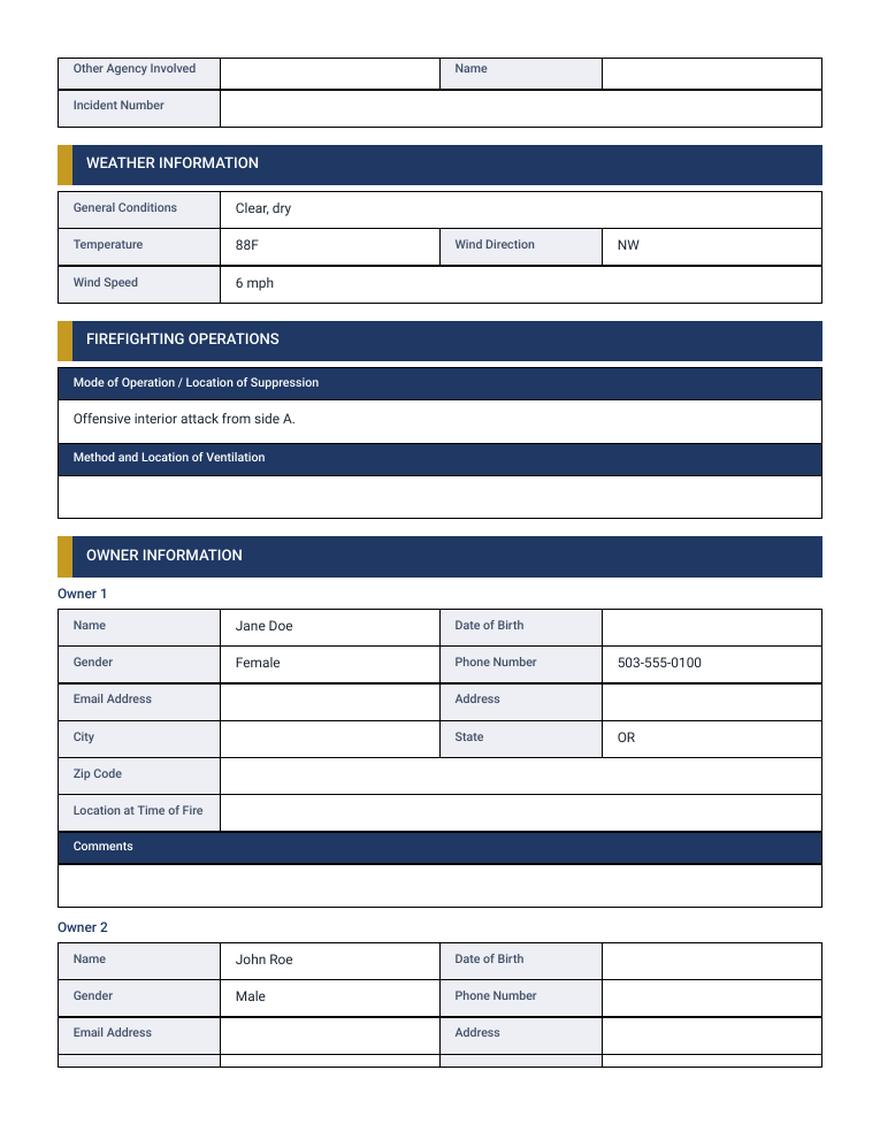
The investigator’s initial report, start to filed, in one pass. Twenty-two sections follow the scientific method through scene examination and classification, photos and a scene diagram embed as you go, and enclosure PDFs merge onto the end. Nothing leaves the device until you download the finished report.
- Twenty-two guided sections with a jump rail and draft save
- Photo log and scene diagram embed directly into the report
- CAD, NFIRS, weather, tax assessor and roster PDFs merge onto the end
- One combined, searchable PDF ready to file in Laserfiche
- Runs entirely in the browser — no data leaves the investigator’s device
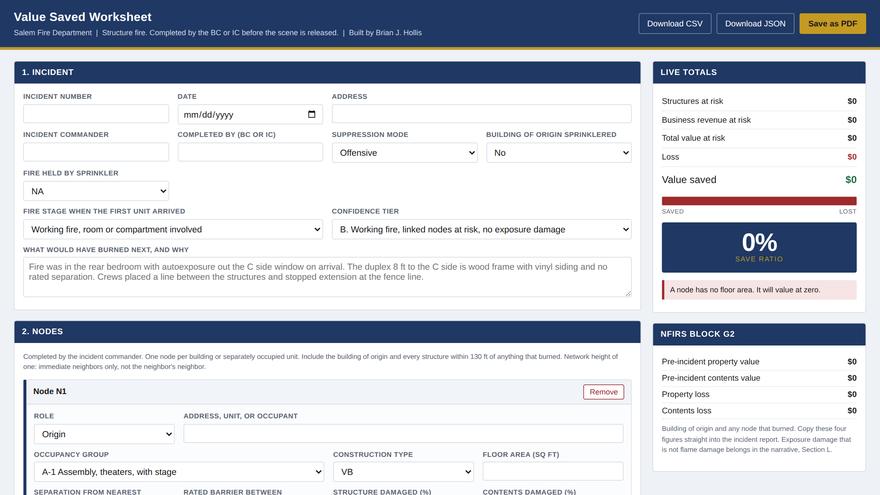
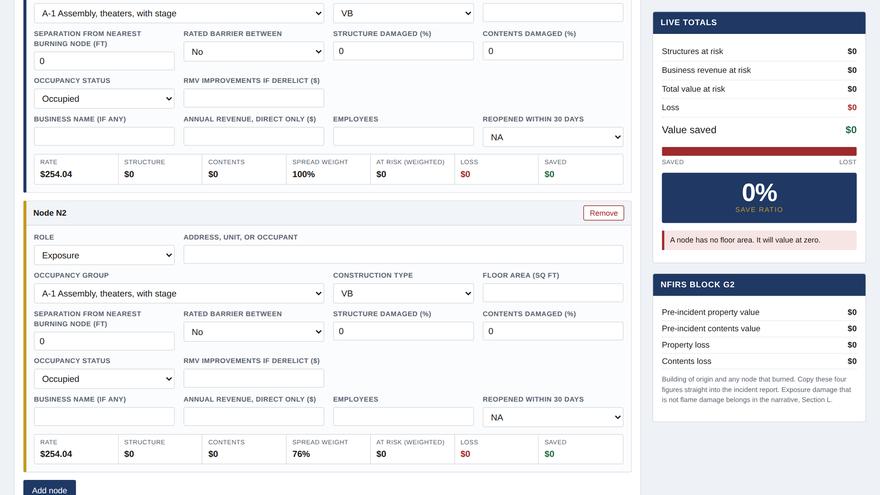
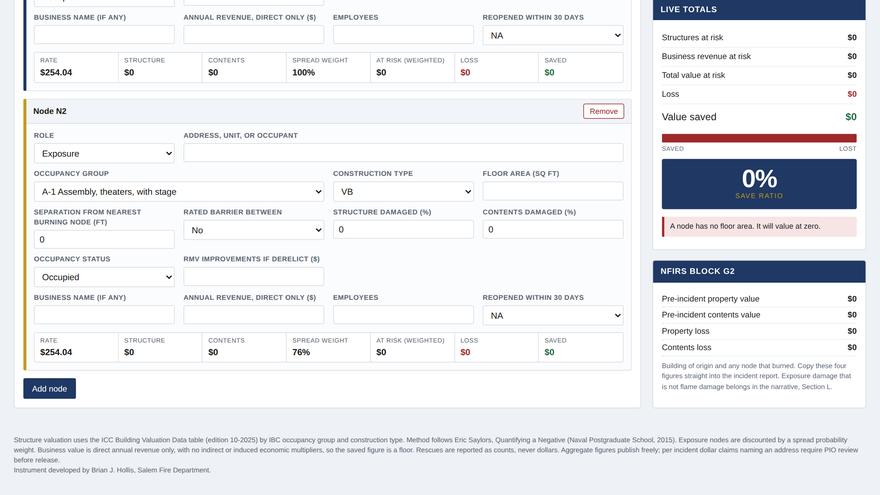
The number your chief gets asked for at budget time, calculated the same way every time. The BC or IC completes it before the scene is released: suppression mode, fire stage on arrival, and a confidence tier, then each exposure node valued separately. Loss and value saved come out the other end with the assumptions written down.
- Completed by the BC or IC before the scene is released
- Confidence tiers keep defensible numbers separate from estimates
- Per-node valuation for every structure and business at risk
- Totals recalculate live — structures, revenue, loss, value saved
- Exports to CSV, JSON or a filed PDF
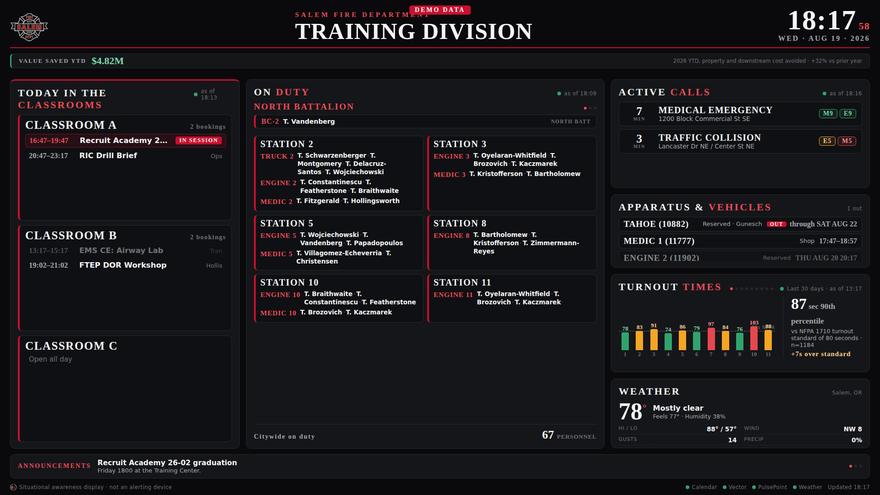
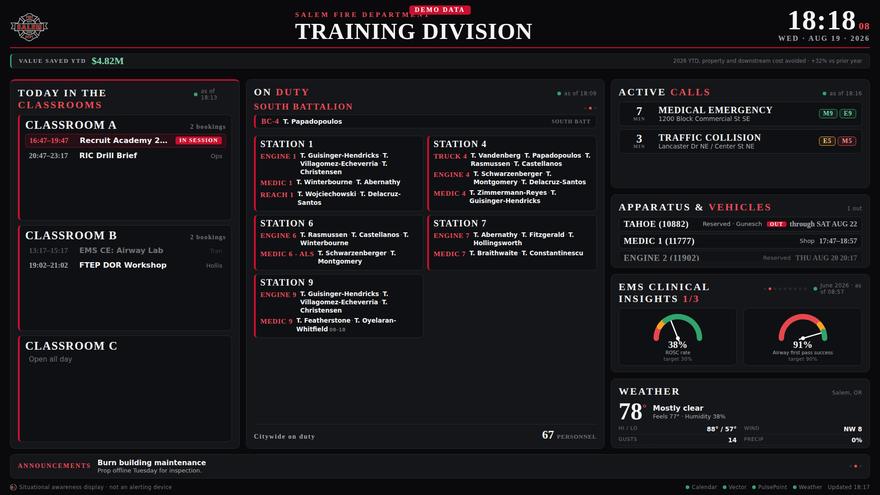
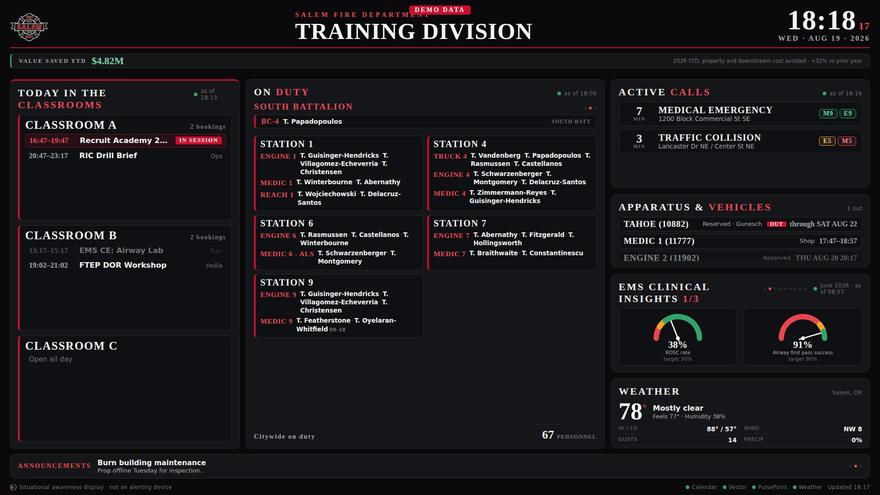
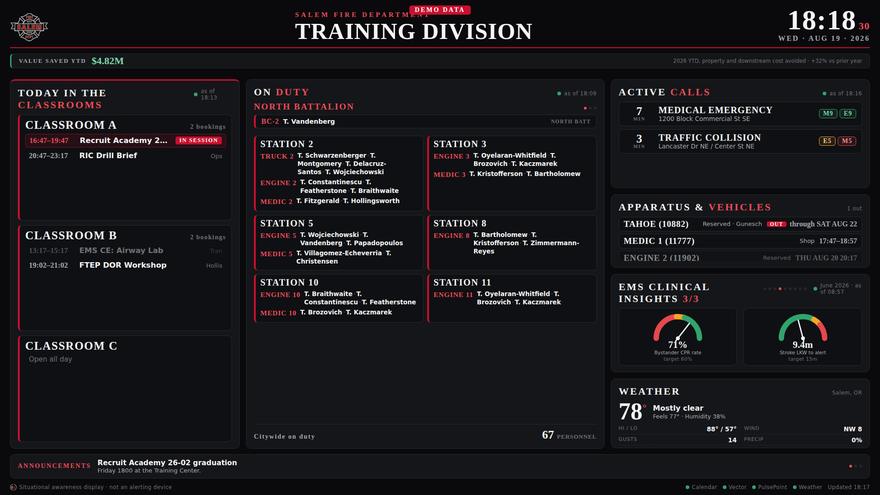
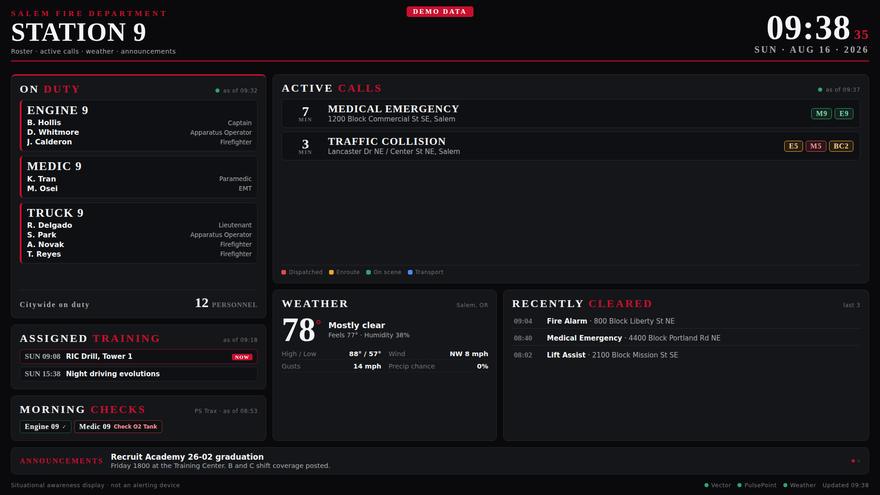
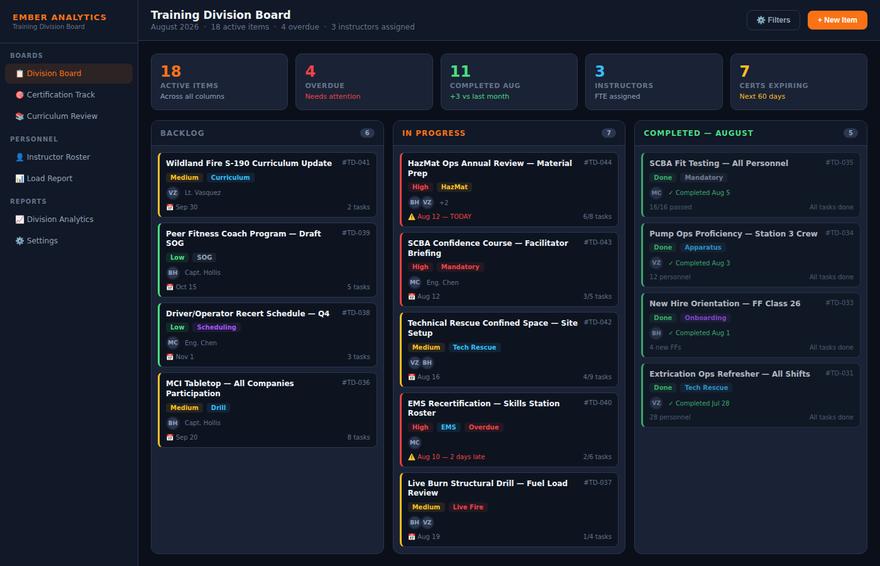
The situational awareness display, deployed wherever your people already look up. One engine drives the watch-desk board, the Training Division screen, and anything else you point it at — on-duty roster, active calls, classroom bookings, apparatus out of service, weather, and value saved, all pulled live and refreshed on their own clocks. It is a picture of the department right now, not an alerting device.
- One engine, many layouts — watch desk, training office, headquarters lobby
- Live sources: CAD / PulsePoint, scheduling, calendar, apparatus status, NWS
- Panels rotate on their own timers so the whole picture fits one screen
- On-duty roster by battalion, station and unit with staffing exceptions
- Turnout percentile and EMS clinical compliance benchmarked automatically
- Portrait or landscape, 1920x1080 native, scales to any display
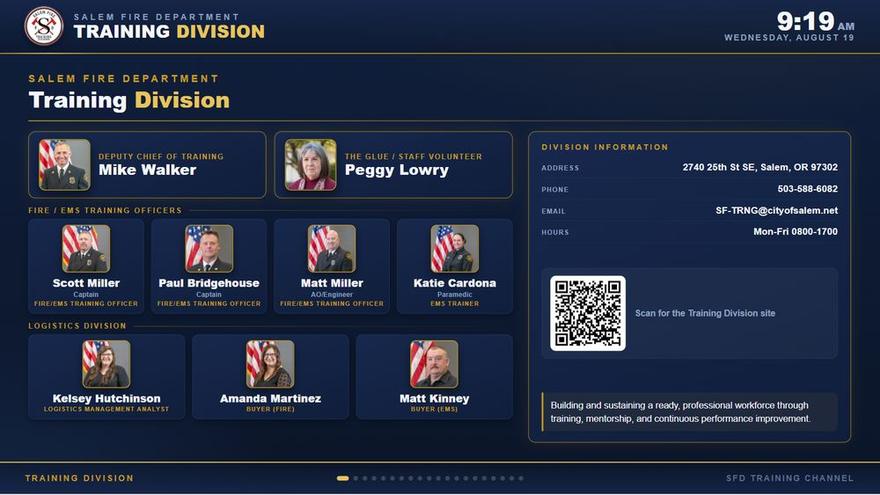
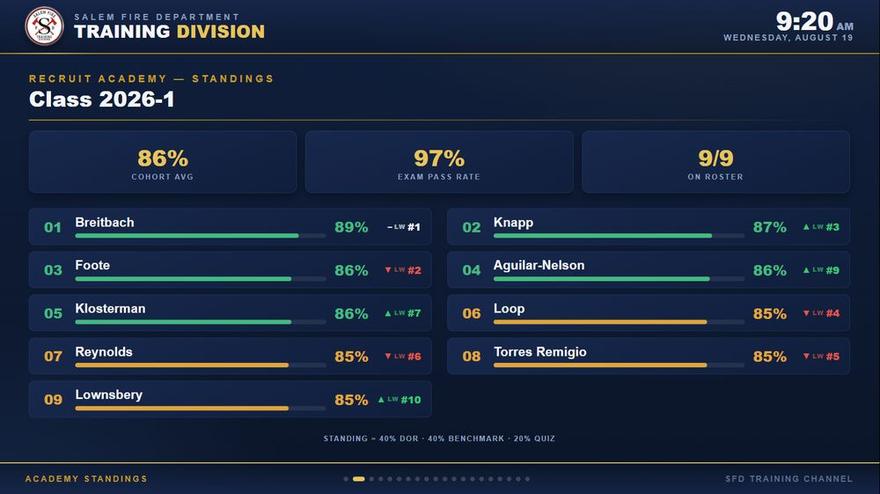
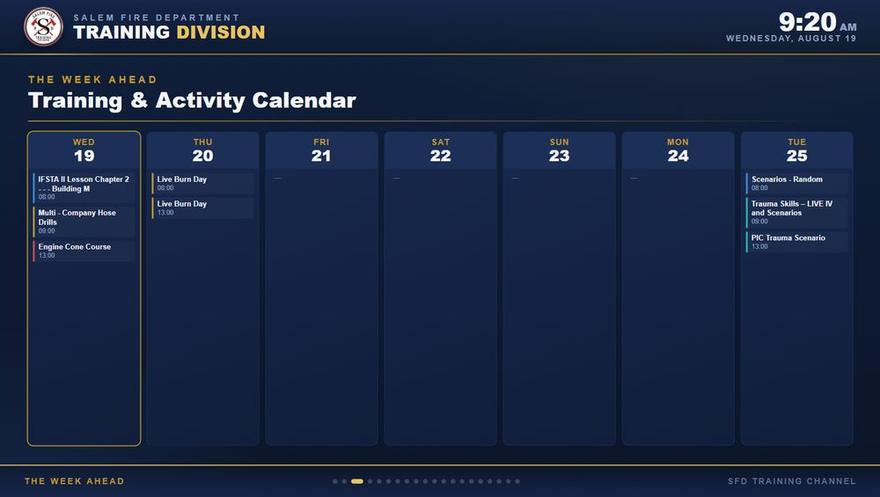
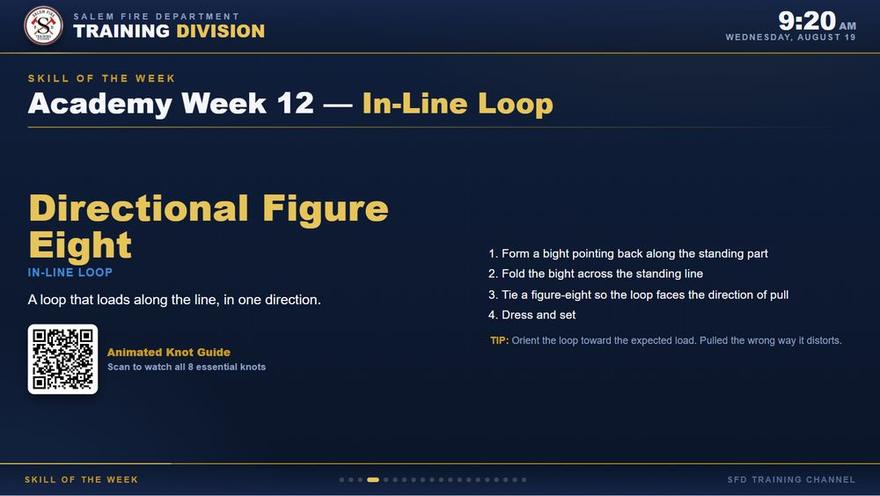
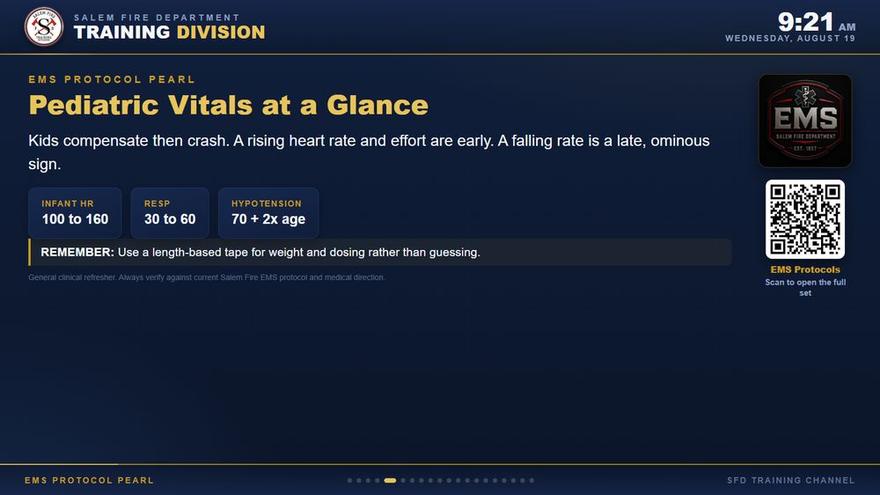
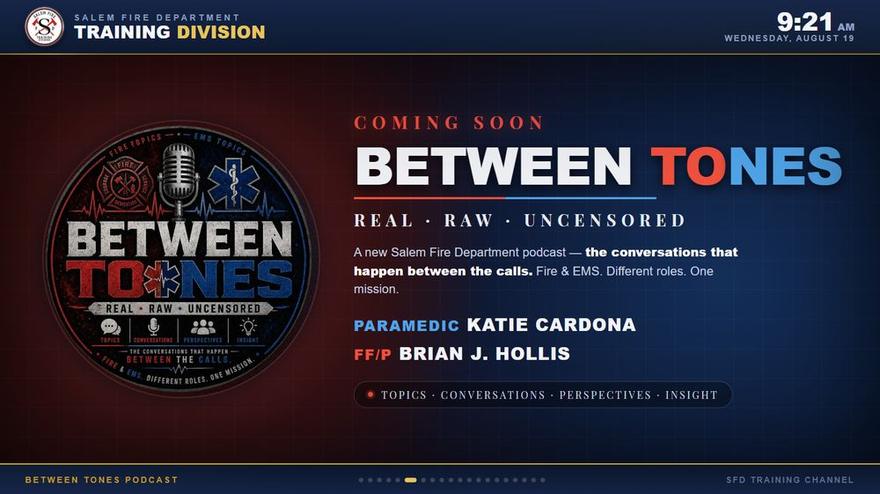
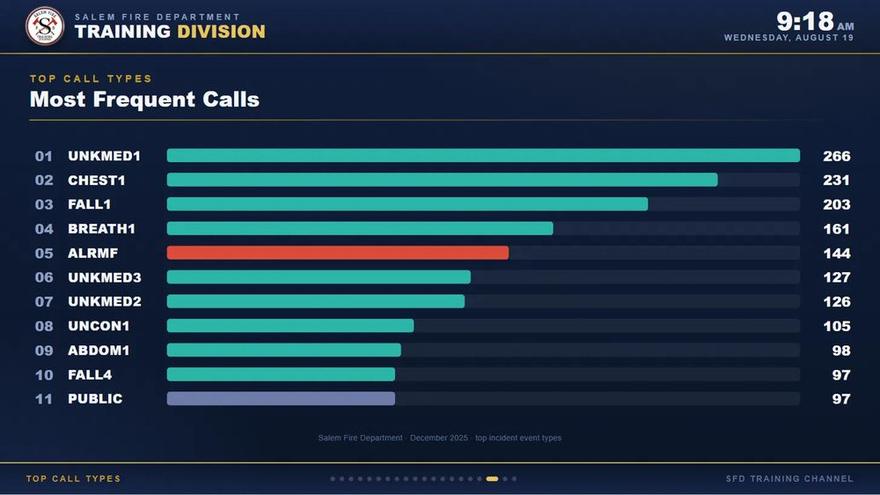
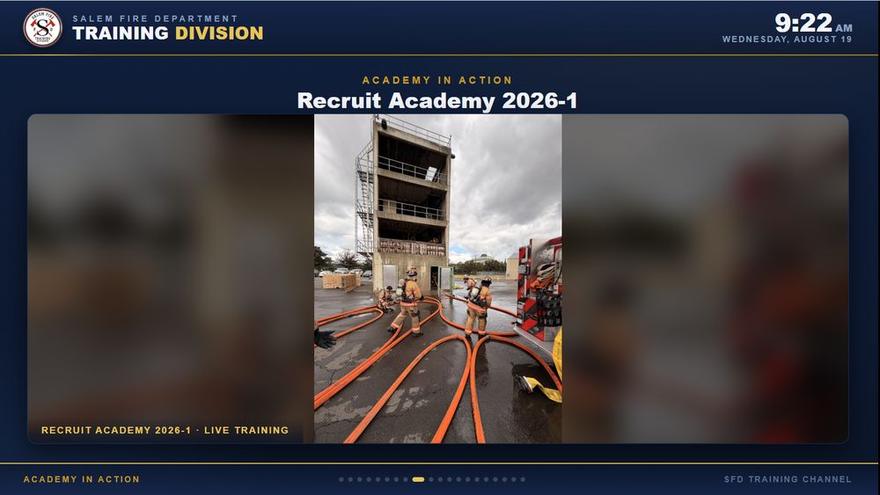
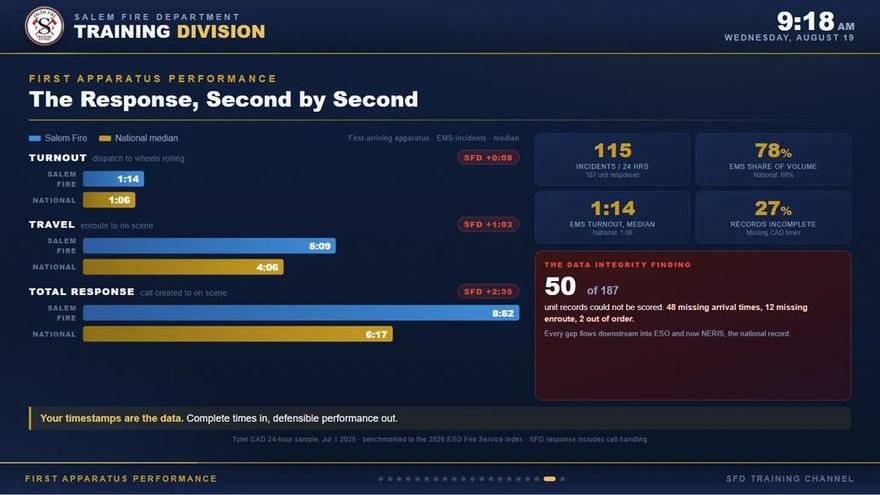
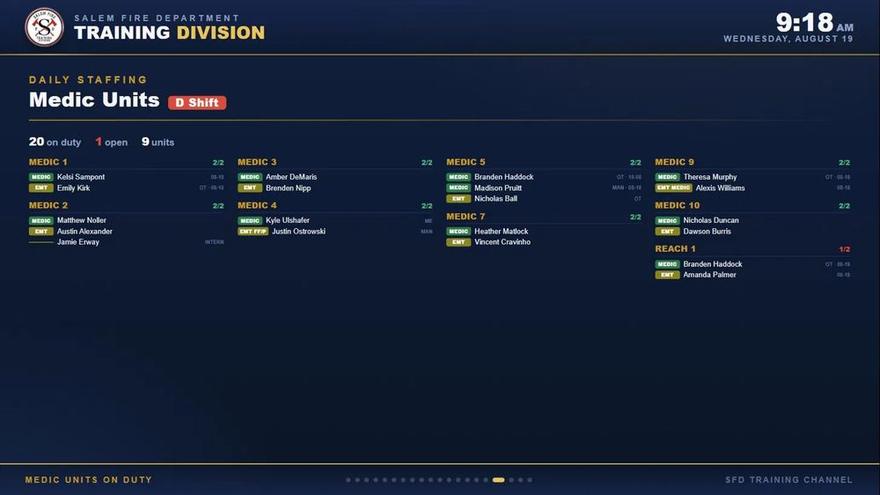
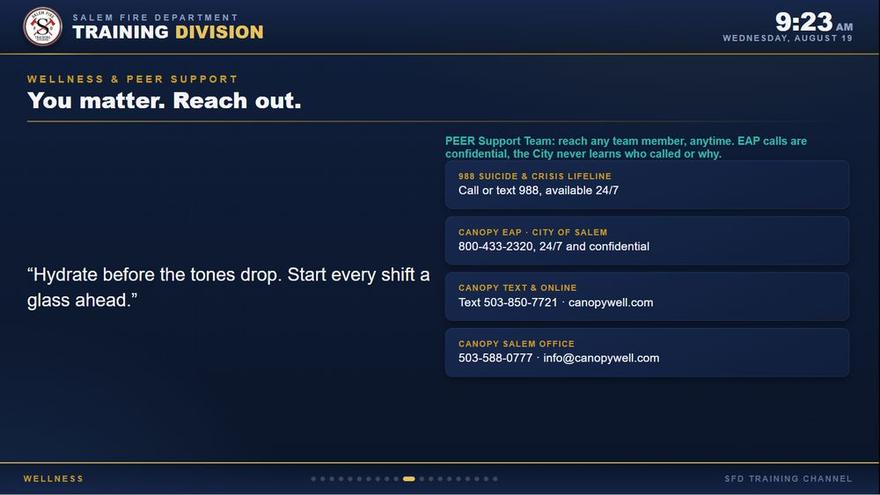
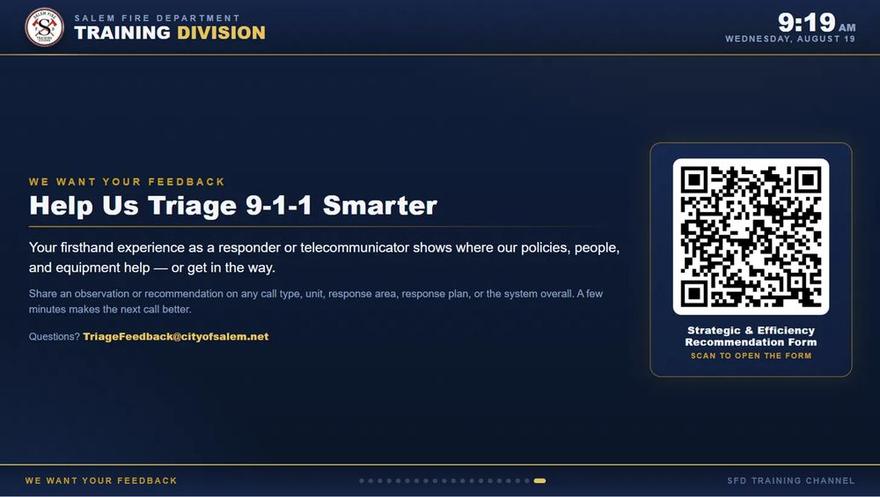
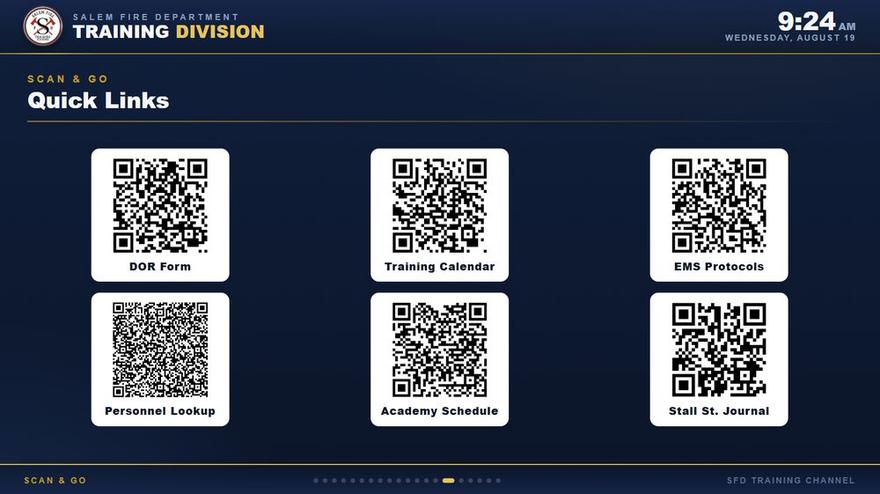
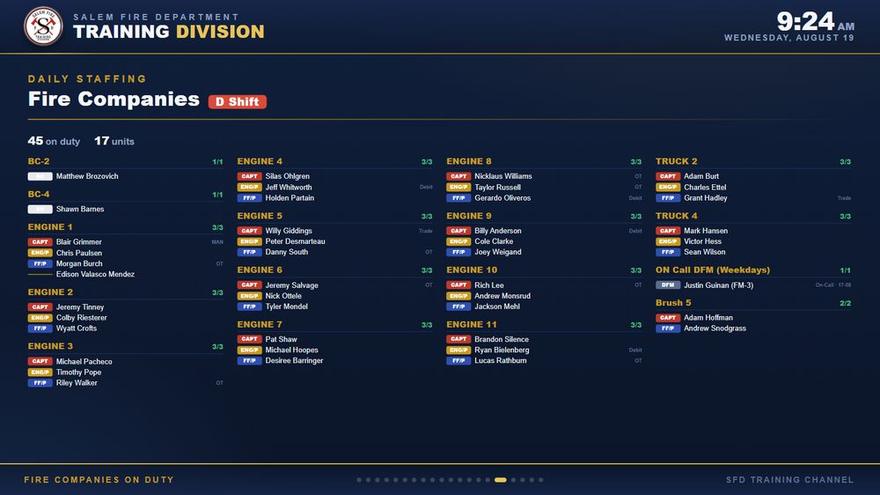
A full-screen channel for the screens your department already owns — day rooms, training classrooms, apparatus bays, headquarters lobbies. Slides pull from live data instead of a deck somebody has to remember to update, and the loop keeps running whether or not anyone is watching.
- Live-data slides: staffing, standings, calendars, response metrics
- Static content too — announcements, wellness resources, QR quick links
- Auto-rotating playlist with per-slide timing and ordering
- Department-branded templates in your colors, logos & typography
- 1920x1080 native, scales to any TV, portrait or landscape
- Runs on any browser-capable player or smart display
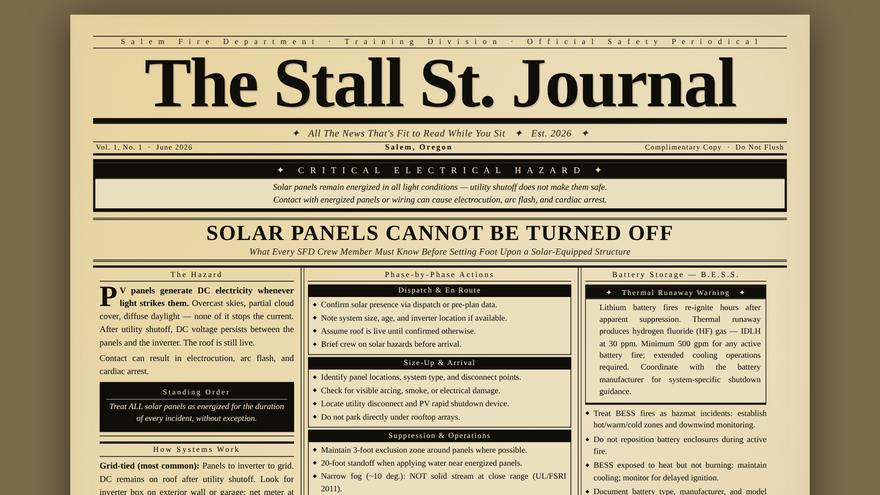
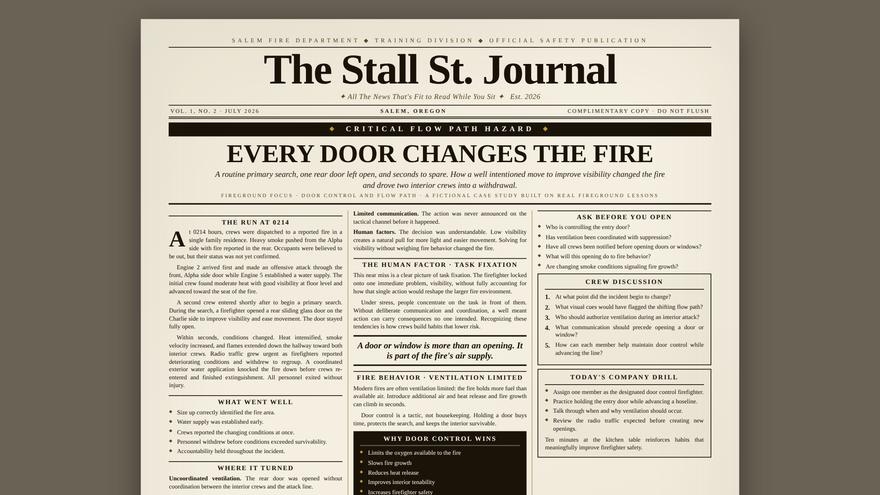
Safety information where people will actually read it. Each issue is a single broadsheet built around one hazard — the physics, the phase-by-phase response, the quick-reference matrix, and the contacts — laid out to be absorbed in the four minutes somebody is sitting there. Print it, post it, and the training happens without a class.
- One hazard per issue, front to back, no continuation pages
- Quick-reference matrices and contact tables built for glance reading
- Fireground case studies written from real lessons, not vendor copy
- Print-ready broadsheet, posts anywhere in the station
- Department-branded and written to your SOPs
Reporting dashboards that pull operational data and generate the outputs your chief needs for city council briefings and accreditation reviews. No manual data pulls.
- Automated performance dashboards
- Response time analytics
- Staffing trend reports
- City council & accreditation reporting
What fire officers say
The MOT tracker cut our force-hire call time from 20 minutes to under 3. We used to have captains cross-referencing spreadsheets and the collective bargaining agreement at the same time. Now the list is just there.
ASHER finally replaced the binder system we'd been dragging to pre-plans for 15 years. Crews can pull up a target hazard from the apparatus on the way to a call. That's the only version of pre-incident planning that actually gets used.
The tabletop builder let us run a full multi-agency exercise with 40 participants and complete documentation in one afternoon. We used to spend two weeks building the scenario in PowerPoint and still end up with a mess.